
Find People Through Greenville Records
Greenville creates city records, but many of the best name trails sit with Pitt County or North Carolina. City files cover council work, boards, permits, police reports, staff, and cemetery records. Pitt County keeps deeds, parcel ownership, local vital certificates, elections, and trial-court files. State systems add court cases, business filings, licenses, correctional records, unclaimed property, and voter data. Start with the office tied to the fact already known.
A full name works best in a deed, court, voter, staff, or business index. An old street address points first to the parcel system, then to the deed reference and past owners. A school, city department, or public role calls for an institutional directory. For someone from an earlier era, a city directory, yearbook, obituary, census page, or estate file may be far more useful than a current web search.
- Write down the name, spelling variants, date range, and any known address or group.
- Check Pitt County land and parcel indexes for a title or address link.
- Use the North Carolina court party search, then ask the local clerk for the full file.
- Move to voter, business, license, school, library, and obituary sources that fit the person.
- When the web trail stops, search the courthouse terminal or request the existing record from its custodian.
Use records lawfully. Public access does not permit stalking, threats, harassment, or harm. Verify identity before drawing a conclusion about anyone.
Greenville Search Offices by Custodian
Three counters handle much of a Greenville name search. The Pitt County Register of Deeds maintains land instruments and Pitt vital records. The Clerk of Superior Court keeps local civil, criminal, estate, and special-proceeding files. Greenville’s City Clerk preserves council minutes, ordinances, resolutions, contracts, proclamations, and other permanent city records. Tax Administration and GIS support the county parcel system, while the City Clerk can route a request for an unposted municipal record.
Greenville is the Pitt County seat, so all three main counters are local. Yet their roles are not interchangeable. North Carolina does not use the court clerk as the land recorder. Ask for an existing file or index and give a date range, party name, parcel number, book and page, or case number. Detailed access and fee rules belong with the Greenville public records system.
Pitt County Register of Deeds
100 E. First St.
Greenville, NC 27834
252-902-1650
All three offices offer an offline path. The deed and court counters keep material that may not appear in a remote result, while the city accepts focused requests for records held by its departments.
Greenville Deed Search in Two Roles
Pitt County describes its online real-estate record range as September 1762 to the present. The Cott eSearch index can search a grantor, the party giving an interest, or a grantee, the party receiving it. Run both roles. A person may buy land in one record, sell it in another, join a spouse or co-owner, or appear through a trust or estate. Date and document-type filters help separate common names.
The official Pitt County deed name search shows how its party and date controls work.
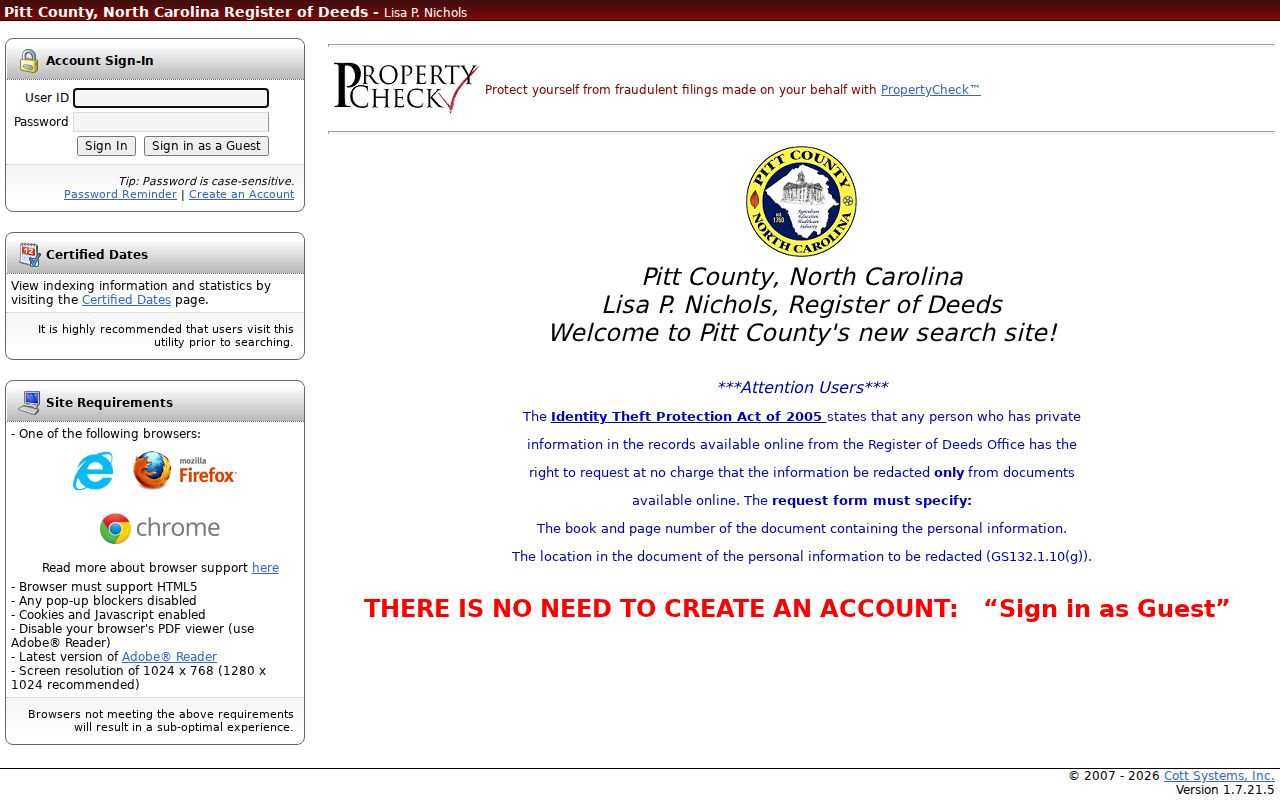
Results can show party roles, instrument type, filing date, legal-description text, book and page, amount fields, and image availability. Guest access needs no account. Difficult spellings or older metadata may still require the alphabetical grantor and grantee books at the Register of Deeds counter.
| Deed control | Use in a Greenville search | Required |
|---|---|---|
| Grantor or grantee | Find a seller, buyer, or other title party | One party route |
| Document type | Limit deeds, releases, plats, or other instruments | No |
| Book and page | Open a known recorded reference | Paired |
| Date range | Narrow filings to the likely period | No |
Note: The county’s deep document range does not guarantee that every early name has perfect modern search metadata.
Greenville Court Record Search
Pitt County joined North Carolina eCourts in April 2025. The statewide Portal now supplies Smart Search for a party, business, attorney, citation, judgment, or case number. Choose Pitt County as the location and add a filing range, status, or case type when a name returns too much. The separate Court Dates tool finds scheduled matters by name, citation, and county.
The North Carolina eCourts Portal capture shows the current statewide route serving Greenville.
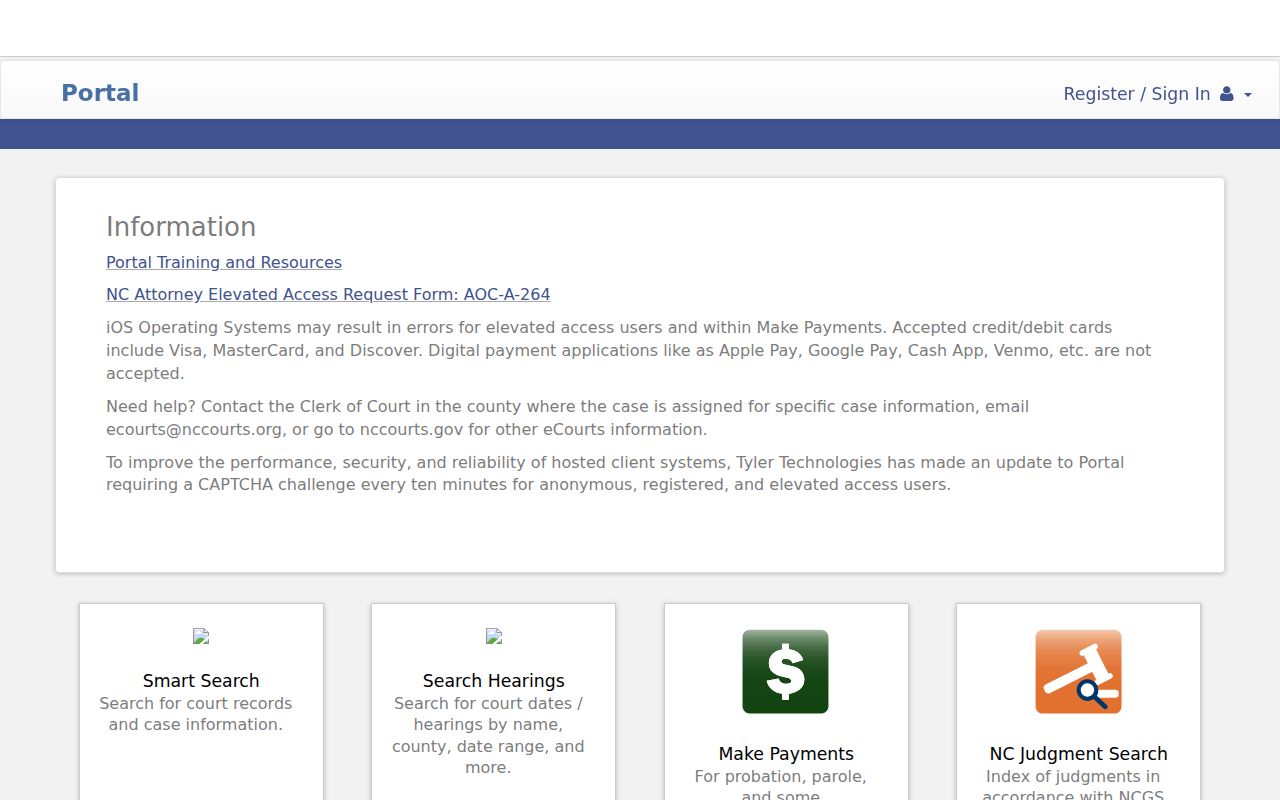
A public result may include case summary, parties, assignments, events, hearings, dispositions, and financial data when available. A docket is the running list of case activity. It is not the full file, and a filing or charge does not prove fault. Juvenile, adoption, involuntary-commitment, sealed, and expunged matters are absent or restricted.
| Greenville court source | What it covers | Access path |
|---|---|---|
| Pitt District and Superior Courts | Civil, criminal, traffic, estate, and special proceedings | Portal, courthouse terminal, or clerk file |
| North Carolina Court Dates | Upcoming sessions by party or citation | Free statewide search |
| Eastern District federal courts | Federal district and bankruptcy cases | PACER or federal clerk |
The courthouse terminal can search criminal records by defendant, victim, or witness name and also exposes civil, estate, and special-proceeding data. Inspect or order the complete or certified file from the Clerk in the county where it was filed.
Greenville Vital Record Routes
The Pitt County Register of Deeds issues certified Pitt birth, death, and marriage records. North Carolina Vital Records handles statewide registration and certificate services. A Pitt divorce judgment comes from the Clerk of Superior Court where the case was granted, while the state divorce certificate is a different statistical record. These are certificate request channels, not unrestricted name indexes.
G.S. 130A-93 limits certified birth and death copies to qualified people such as the subject, spouse, sibling, direct ancestor or descendant, certain step relations, someone establishing a personal or property right, or an authorized representative. Statewide registration began October 1, 1913. Earlier family research often shifts to deeds, church or cemetery sources, newspapers, family papers, and archival collections.
Since January 2026, county Registers may issue an amended adoptive birth certificate through NCDAVE. The original pre-adoption certificate and adoption case remain sealed. That change adds a local certificate channel but creates no public adoption-name lookup.
Greenville OPIS Address Search
The Pitt County Online Parcel Information System, or OPIS, turns an owner name or street into a parcel trail. Search by owner, address number and street, parcel number, NCPIN, deed book and page, neighborhood, fire-tax district, value, acreage, or sales price. A parcel is a mapped tract for tax and land administration. Its situs address is the parcel’s physical location, while the owner mailing address is where tax mail goes.
The official Pitt County OPIS search begins with a disclaimer and map interface.
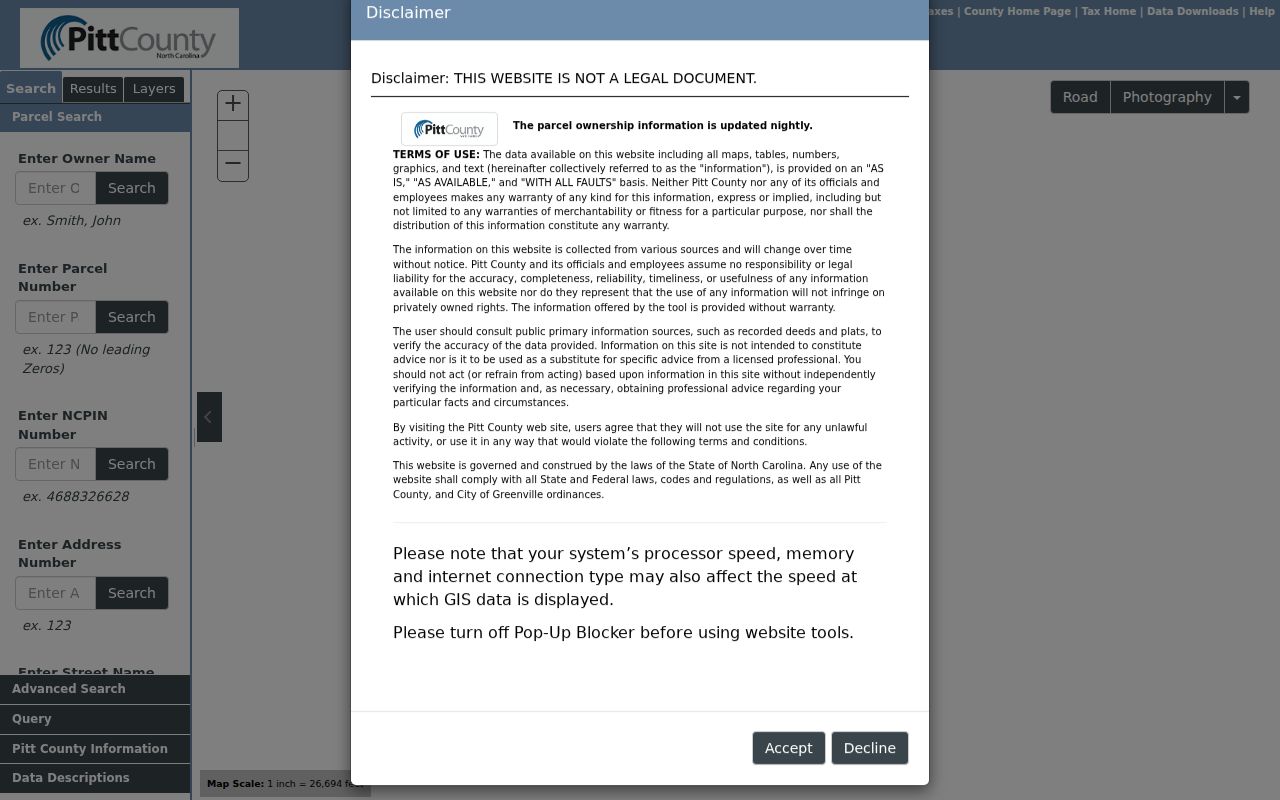
Owner data update nightly, but OPIS remains a cross-reference map. Copy the parcel IDs, physical and mailing addresses, deed reference, sale data, and district fields. Then verify title in the recorded deed or plat. A newly filed deed may reach the Register before the parcel roll changes.
Insider tip. The mailing address may locate an owner away from the Greenville parcel, but neither address alone proves where that person lives.
Greenville Voter Lookup Limits
The North Carolina Voter Search can confirm a public Greenville registration by first and last name, with optional middle initial, birth year, Pitt County filter, and status choices. A matched page may show registration status, public address unless protected, party, precinct, municipality, electoral districts, polling place, sample ballot, absentee status, and participation history. It never shows selections made on a ballot.
Full birth dates, Social Security numbers, license numbers, certain email data, voter-ID images, and protected addresses remain confidential under G.S. 163-82.10. A no-match can reflect a spelling or preferred name, wrong year or county, a move, an unchecked removed status, pending review, or protected handling. For search fields, file layouts, county help, and privacy rules, use the Greenville voter registration lookup.
Note: Participation history records the election and voting method, never the candidate or issue choices marked by the voter.
Greenville Search Beyond the Portal
Remote databases are only one access channel. The Register of Deeds keeps legacy alphabetical books and provides counter copies. The courthouse has public terminals and the Clerk holds full local case files. The City Clerk accepts a focused request for municipal records, and Greenville Police provides crash, crime, arrest, and case report routes online or through its Records window. Sheppard Memorial Library and ECU Special Collections serve historical searches that cannot be solved by a current portal.
North Carolina Public Records Law lets any person inspect open records at reasonable times without stating a purpose. Copies must be supplied as promptly as possible, but the law sets no universal number of days. Ordinary uncertified copies cannot exceed actual reproduction cost. An unusually demanding request may support a reasonable special service charge. The custodian must separate confidential material from an otherwise open record instead of closing the whole file for that reason.
- Index
- A list that points to a record; it may not contain the full document.
- Certified copy
- A copy the custodian formally attests as true, often for a set fee.
- Custodian
- The office responsible for keeping and providing the record.
- Redaction
- The removal of protected details while the rest remains available.
Greenville Historical Directory Search
Historical names need sources built for their era. DigitalNC has verified Greenville city directories for 1916-17 and 1926-27. The later volume includes alphabetical residents, classified businesses, addresses, occupations or employers, and sometimes a spouse marker. Search the surname, then inspect street and business sections. Publisher errors, abbreviations, optical text errors, and the period’s bias require a second source.
Greenville High Tau yearbooks cover a verified 1918-57 run. ECU’s yearbooks began with Tecoan in 1923, changed to Buccaneer, have documented gaps, and continued through successor Anchors Away volumes listed to spring 2024. Sheppard Memorial Library adds the Daily Reflector archive from 1999 forward, HeritageHub obituary and death notices, onsite genealogy databases, and local research groups. ECU finding aids lead to Pitt poll lists, tax lists, family papers, deeds, and petitions.
Place names also change the result. Greenville was Martinsborough in its early incorporated years and Greenesville after 1786. Pitt County formed from Beaufort County in 1760, so an earlier record can sit under another county or town name. Municipal cemetery records present a different gap: Greenville says official burial records before October 1984 are unavailable despite much older cemetery grounds.
Greenville Business and License Search
A business name can lead to people in official roles. The North Carolina Secretary of State business index can show a legal entity, status, formation data, registered agent, office and mailing addresses, officials, annual reports, and filing images. An agent is a formal contact, not proof of ownership. Assumed business names filed since December 2017 are compiled statewide, while older filings remain with the county Register of Deeds.
Professional status is board-specific. North Carolina offers official searches for physicians, lawyers, general contractors, notaries, and other licensed fields. Search results can identify a credential, public status, dates, business location, or published discipline. Greenville’s city and county staff directories, the ECU faculty and department directory, the Pitt Community College personnel directory, and the Chamber member directory add institutional roles. Each role should be read on its own terms.
| Official source | Best use | Main limit |
|---|---|---|
| Secretary of State | Entity, agent, official, and filing trail | Agent may not be owner |
| Licensing board | Credential and public status | Fields vary by board |
| Institutional directory | Listed role and contact route | Entries can lag or be suppressed |
Greenville Offender Search Boundaries
Public safety searches have separate keepers. Pitt County’s detention lookup covers current detainees and refreshes hourly. The North Carolina Department of Adult Correction searches current and inactive custody or supervision records. The State Bureau of Investigation registry searches registered offenders by name, place, address area, or registration number. Each database covers only its stated population and can change.
The official North Carolina SBI registry capture shows its available public search modes.
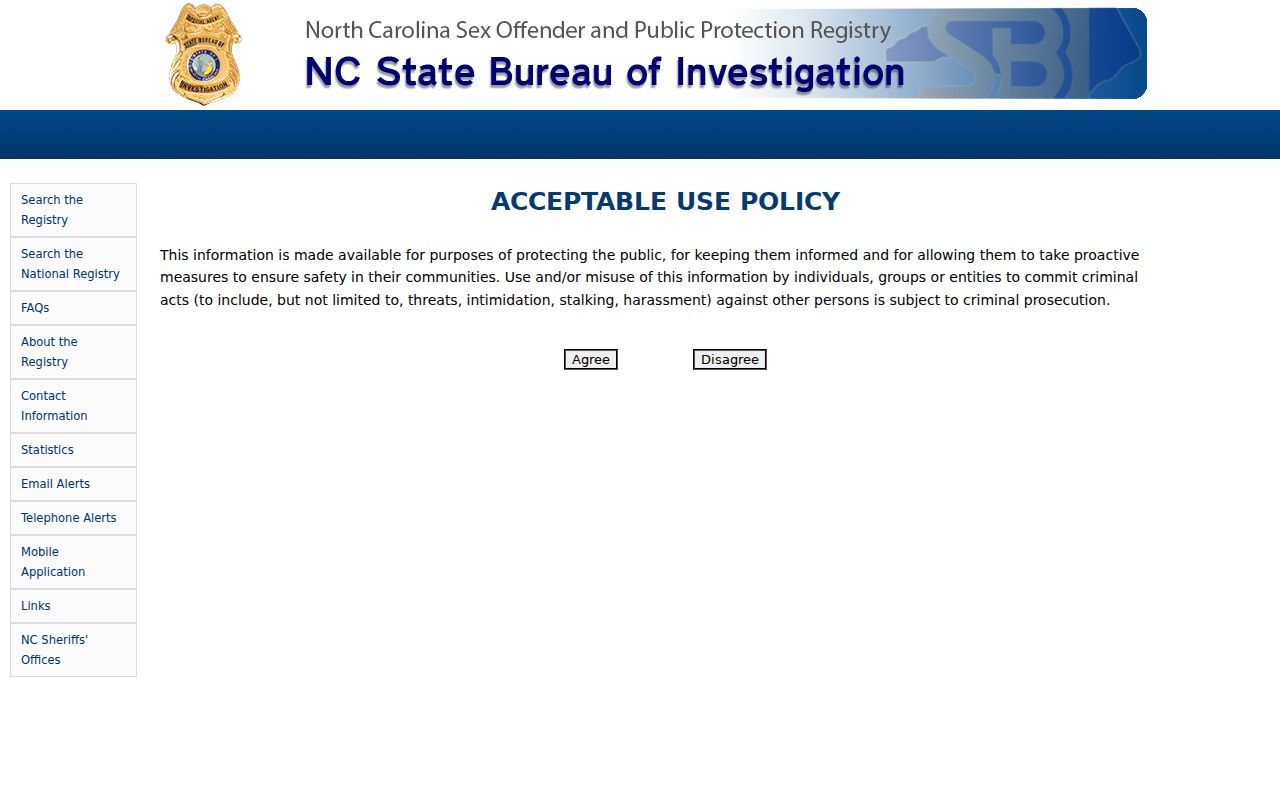
A registry entry should be checked against its official details and current status. The registry itself warns against threats, intimidation, stalking, or harassment. For custody changes, North Carolina SAVAN offers anonymous notification by web, app, or phone. For a Greenville police report, use the Records Division’s published online or counter route rather than treating a registry or jail result as a complete case file.
Greenville NCCash Name Lookup
Unclaimed property offers a narrow but useful statewide name trail. NCCash lists owner names with a reporting location or holder clue and provides a free claim process. A match may help distinguish someone tied to Greenville, but it does not establish a current address or relationship. Claim evidence remains part of the secure process rather than the public result.
The official NCCash name-search interface is the source for this lookup.
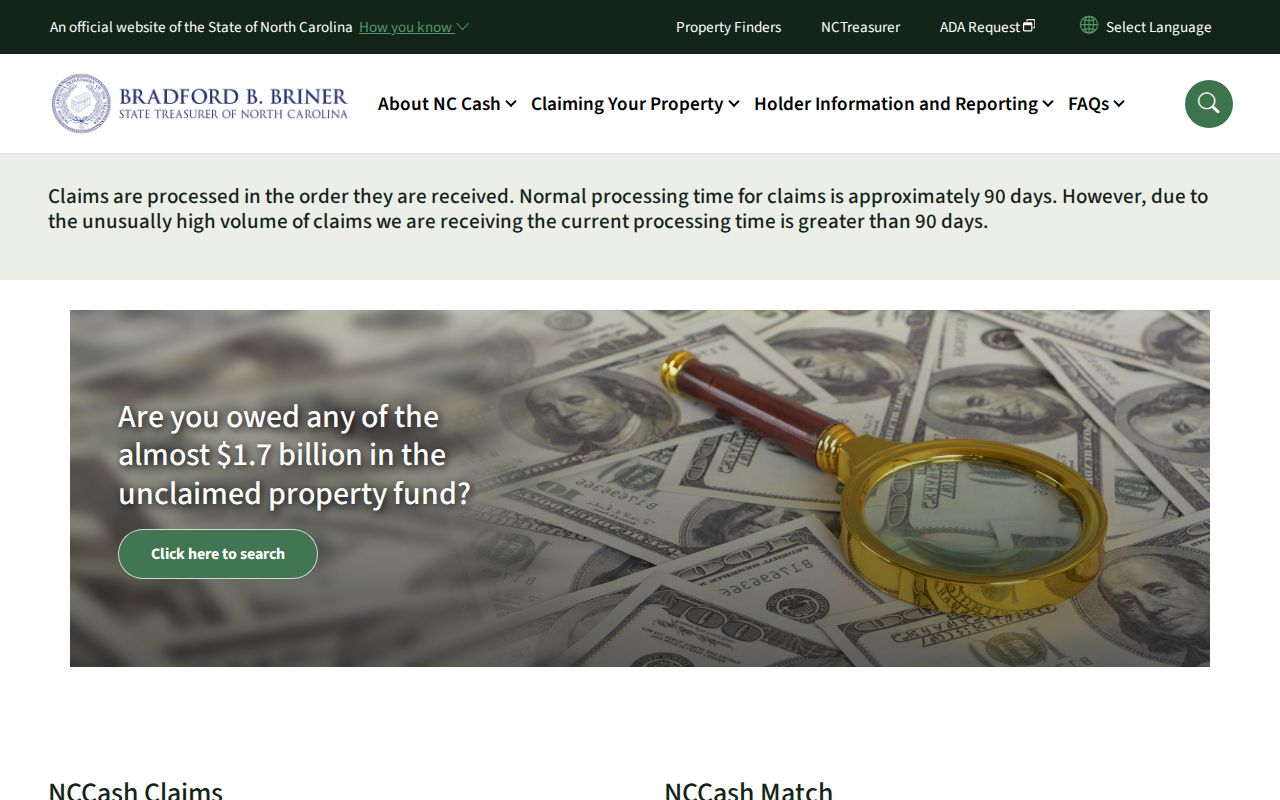
Search likely spelling forms and compare the reporting place or holder with known Greenville facts. Treat the match as a lead until the Treasurer’s claim process verifies identity. No fee is needed to search or file a claim through the official state service.
Greenville Address Trails After Floyd
Greenville’s place history can explain why an address trail breaks. Hurricane Floyd and Tar River flooding in 1999 produced buyout, mitigation, relocation, demolition, rebuilding, permit, deed, and flood-map records. A parcel transfer or disappearance from a reverse directory after the flood may reflect a property event rather than an unexplained personal move.
City growth also matters. A Greenville mailing address does not prove that a parcel sat inside the municipal limit at the relevant time. Check the OPIS municipality and district fields, the city limit or address layer, recorded deeds, and the permit custodian. For an old occupant, add a city or reverse directory, newspaper, obituary, and estate file. Ownership, postal place, tax district, and occupancy answer different questions.
The sound chain is simple: address to parcel, parcel to deed, deed to past owner, then directory or newspaper to occupant. That layered method preserves the local context that a one-box name search cannot supply.