
Greenville People Directory Landscape
Greenville people directories are split among city, county, campus, state, and archival keepers. No single list represents everyone who lives or once lived in Greenville. Government directories identify people in public roles. Campus sources identify faculty, staff, departments, and people shown in past yearbooks. Property and deed indexes identify owners or recorded parties, while older city directories connect published residents and businesses with street addresses.
| Directory | People or Roles Listed | Keeper | Access Route |
|---|---|---|---|
| City staff directory | Greenville employees and departments | City of Greenville | Free web search |
| County staff directory | Pitt County employees and offices | Pitt County | Free web search |
| ECU directory | Faculty, staff, and departments | East Carolina University | Public staff search; student login |
| OPIS and deed index | Parcel owners and recorded parties | Pitt County | Free web portals; office indexes |
| Business and license lists | Officials, agents, members, and licensees | State boards, Secretary of State, Chamber | Free web lookups |
| Historic city directories | Published residents, firms, and addresses | DigitalNC and local repositories | Digitized PDFs; library inquiry |
| School yearbooks | Students, faculty, teams, and clubs | DigitalNC and ECU | Digital volumes and finding aids |
Choose a Greenville directory by the role being tested. A city employee belongs in the municipal staff search, and an ECU office belongs in the campus search. A person tied to land may appear in OPIS or the Register of Deeds index. A past Greenville resident is more likely to surface in a period city directory, yearbook, newspaper, obituary collection, or manuscript finding aid. Each match should be read as evidence of a stated role, not proof of residence.
Note: A name missing from one Greenville directory may still appear under a preferred name, former surname, agency, street, or historical place name.
Greenville City Directory Fields
The Greenville city staff directory supports both name searching and department browsing. It is useful when a Greenville resident needs the right public contact, or when a council record, permit, or city document names an office without a direct number. A visitor must choose a department or enter a first or last name. The text fields accept up to 30 characters, and JavaScript must be available.
| Search Field | Control | Required | How Greenville Uses It |
|---|---|---|---|
| City Department | Dropdown | Conditional | Browse one city unit |
| First Name | Text, 30 characters | Conditional | Use alone or with surname |
| Last Name | Text, 30 characters | Conditional | Use alone or with first name |
| Search | Button | Action | Requires a department or name |
Department choices range from the Clerk, City Manager, Engineering, Fire/Rescue, Police, and Information Technology to Recreation and Parks, Code Enforcement, and Community and Development Services. Broad department browsing can help when the name spelling is uncertain. Results can be sorted and paged, but the city promises no archive of old entries.
The live interface is visible in the official Greenville directory source.
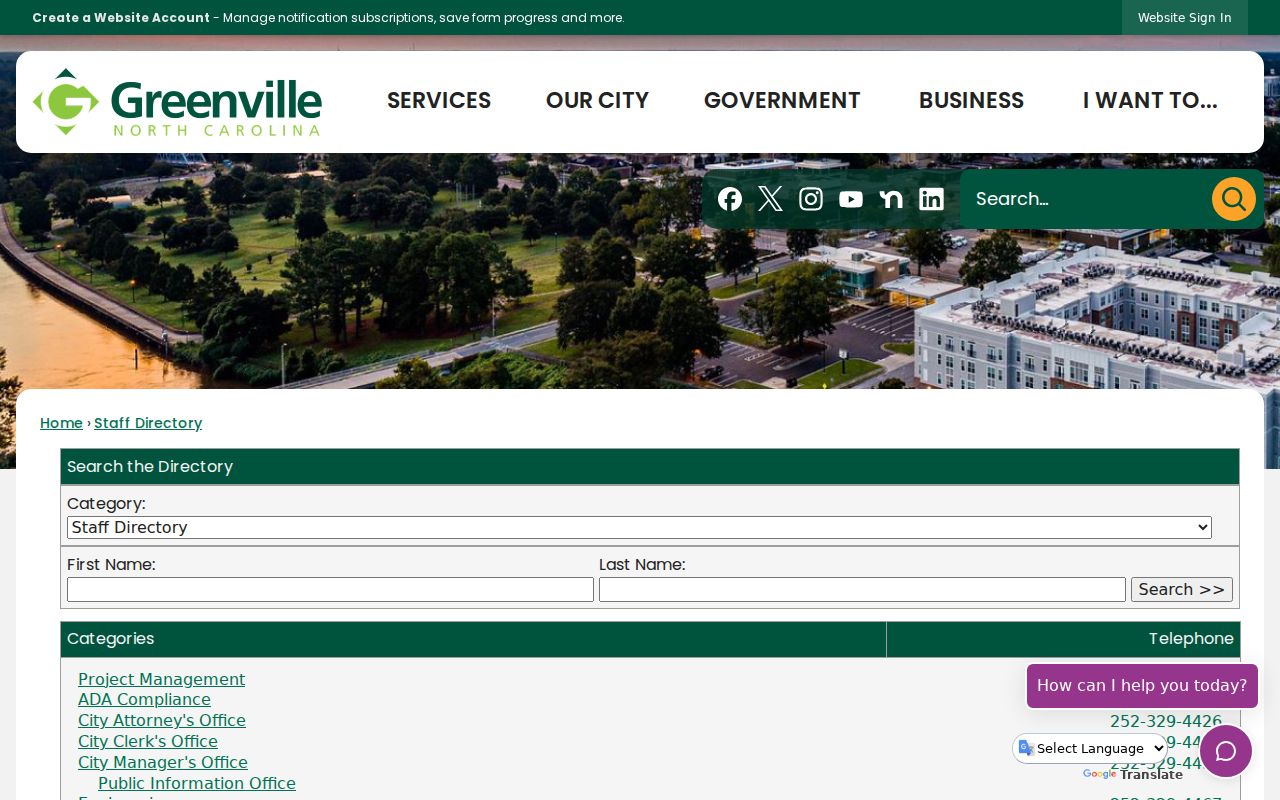
The captured form shows why a department browse is a practical fallback when a full Greenville staff name is not known.
Greenville Government Directory Entries
A Greenville staff result can reveal much more than a switchboard number. The city’s sample clerk entry shows a named person, the City Clerk title, an email link, and a direct telephone number. Other entries can include department and physical or mailing address details. These are official contact fields. They do not establish where an employee lives or whether the person still holds an unlisted prior role.
- Name
- The published staff name, sometimes shown surname first.
- Title and department
- The employee’s listed Greenville role and organizational unit.
- Email and work phone
- Official contact channels, which may be direct or departmental.
- Office details
- Physical address, mailing address, room, fax, or an additional phone when supplied.
The Pitt County directory uses a similar category, first-name, and last-name search. Its categories include Elections, Register of Deeds, Tax, GIS, Sheriff, the County Manager, and Commissioners. For a state agency contact, the North Carolina employee directory takes first or middle name, last name, and agency. If a Greenville name is absent, try the office’s category, department main line, elected roster, or the responsible clerk. An unposted municipal record can also be requested by describing the record and a date range.
Greenville Campus People Directories
East Carolina University is Greenville’s largest local institutional directory source. Among Greenville people directories, the ECU directory searches public faculty and staff by first and last name, while department tools accept a title or phone number. Department browsing spans an indexed set of letters. A preferred name controls matching, so someone listed as Beth may not surface under Elizabeth. Faculty and staff edits are reported to appear after one day.
East Carolina University
Search faculty, staff, department title, or department phone. Student contact access requires PirateID credentials.
Pitt Community College
The personnel directory uses one search box. Entries may show name, email, phone, office location, building, and room.
Pitt County Schools
The verified administrative placement list names schools, principals, assistant principals, interns, phone numbers, and fax numbers.
Greenville education directories have firm boundaries. No public ECU alumni-contact directory was verified, and the student lookup is gated. Research found no comprehensive public Pitt County Schools all-staff search. A school’s main office or the district administrative placement list is therefore the documented fallback. At ECU, the department search and campus operator can locate an office when a staff result is suppressed, stale, or filed under a preferred name.
Note: A campus directory match confirms a listed Greenville institutional connection, while access limits and publication gaps can explain a missing person.
Greenville Property Name Directories
Pitt County public records also work as Greenville name directories, but each records a legal role. OPIS searches current-oriented parcel data by owner name, address, parcel number, NCPIN, or deed book and page. The Register of Deeds name index searches grantors and grantees in a county land-record range beginning in September 1762. A grantor transferred an interest; a grantee received one. Neither label means the person occupied the land.
For a Greenville owner search, OPIS can show Name1 through Name3, the physical parcel address, tax mailing lines, deed reference, sale details, legal description, values, and district layers. The mailing address is structurally separate from the parcel’s physical address and may identify an owner who lives elsewhere. Ownership updates nightly. Yet Pitt County directs users to the recorded deed or plat for the controlling fact, and difficult historical spellings may require the legacy alphabetical books at the Register of Deeds office.
Greenville geography matters. A postal Greenville address does not prove city jurisdiction. Check the OPIS municipality field before assuming a City Hall directory or record should contain the name.
The voter file can function as another public name directory, with statutory limits and protected addresses. Its fields and rules belong with Greenville voter registration records. Deed and parcel access rules are covered with the broader Greenville public records system.
Greenville Business Role Directories
The North Carolina business registration search connects a company name with official roles. Results can show legal name, SOSID, status, formation details, registered agent, registered office, mailing and principal-office addresses, officials, filings, and document images. An individual or agent search accepts last, first, and middle names. A registered agent is an official contact role and is not automatically the company owner.
Greenville’s Chamber member directory searches a keyword, category, alphabet, and location-style filters. Entries may identify an organization or individual, address, phone, and site. Categories include government, civic groups, churches, health, legal and financial services, funeral and cemetery organizations, retail, and travel. The directory describes membership, not the entire Greenville business population.
Professional directories add credential context. North Carolina provides separate official searches for physicians, lawyers, general contractors, notaries, and other licensed fields. Typical entries show a name, credential number or type, status, city or county, and public disciplinary material when the board publishes it. Search rules differ by board. For example, medical and bar searches accept defined combinations of surname characters and another filter. Older Pitt assumed-name filings remain with the county, while the statewide assumed-name compiler covers filings under the law effective December 1, 2017.
Greenville Historical Directory Eras
Historical Greenville people directories are snapshots rather than a continuous list. DigitalNC has verified Greenville city directories for 1916–17 and 1926–27, published by Commercial Service Company and Ernest H. Miller. The 1926 volume contains alphabetical resident entries and classified businesses. A listing can include name, address, occupation or employer, and sometimes a spouse. Its period racial notation, admitted errors, abbreviations, and publisher bias require careful reading and outside confirmation.
| Era or Volume | Greenville Directory Value |
|---|---|
| 1916–17 | Digitized resident and business directory snapshot |
| 1926–27 | Alphabetical residents, classified firms, addresses, occupations, and some spouse markers |
| 1918–57 | Verified Greenville High Tau yearbook run |
| 1923–2018 | ECU yearbook era, with known title changes and gaps |
| 2019–Spring 2024 | Anchors Away successor listing in ECU’s finding aid |
Sheppard Memorial Library genealogy and local history adds newspapers, obituaries, genealogy databases, and links to local research groups. Its official web pages do not publish a complete year-by-year Greenville reverse, telephone, or printed city-directory inventory. Ask the local-history desk before claiming that a specific year is held. Onsite library computers or public Wi-Fi are required for Ancestry Library Edition and African American Heritage.
Note: For eighteenth-century catalog searches, try Martinsborough and Greenesville as well as Greenville because the town’s name and spelling changed.
Greenville Yearbook Name Directories
DigitalNC’s Pitt County collection reported 469 yearbooks and catalogs at the time of research. Contributors include ECU, Pitt Community College, the C.M. Eppes High Alumni Heritage Society, Sheppard Memorial Library, Farmville Public Library, and the Bethel Heritage Center. Greenville High’s Tau volumes span the verified 1918–57 set, providing portraits, faculty, class, club, and team references.
The ECU yearbook finding aid records a more complex run. Tecoan began in 1923 and became Buccaneer in 1953. Known gaps occur in 1976–78 and 1991–2005, and the title ceased in 2018. Anchors Away followed in 2019, with the finding aid listing through Spring 2024. A miss in one of those gaps cannot establish that a person was not enrolled.
Search a yearbook by surname, then inspect class, faculty, club, team, and image pages. OCR may miss stylized names. An index entry or portrait supports an association with the institution and publication year, not a present address. Greenville’s large mobile campus population makes these sources especially useful for former classmates and faculty who never appear in local land records.
Greenville Obituary Name Directories
Sheppard Memorial Library offers several routes when a Greenville name belongs to a deceased resident or family network. HeritageHub covers obituary and death notices from 1704 forward, while the verified Daily Reflector archive runs from 1999 to the present. America’s News includes thousands of U.S. newspapers. Access may depend on library authentication, and some research tools are limited to library machines or public Wi-Fi.
Greenville cemetery records add a sharp cutoff. The city maintains Brown Hill/Cooper Field, Cherry Hill, Greenwood, and Homestead Memorial Gardens, but its official burial records are unavailable before October 1984 because some graves were unmarked or unrecorded. That absence is not proof that a person was not buried there. Earlier work may require a monument, church or cemetery source, newspaper notice, death certificate, or family record.
Search obituary directories with name variants plus a street, school, church, club, employer, or family name. Then compare dates and relationships with an estate file, cemetery entry, yearbook, deed, or city directory. The ECU Pitt genealogy finding aids can point to poll and tax lists, family papers, ledgers, deeds, births, deaths, and petitions, though a finding-aid match may describe a box rather than a digitized item.
Greenville Directory Gaps and Privacy
No authoritative current residential white-pages service was verified for Greenville. The documented Greenville people directories also exclude any public neighborhood or congregation membership list, public ECU alumni-contact list, trade-union roster, or complete public Pitt County Schools staff portal. These gaps should remain gaps. Chamber categories, campus archives, newspapers, and official records can supply lawful leads, but they do not make private member lists public.
Other missing names reflect design choices. ECU student details require a login. A faculty member may be indexed under a preferred name. Staff pages can lag a change or omit an entry. North Carolina’s Address Confidentiality Program gives qualifying relocated survivors a substitute address and mail forwarding, and protected voter addresses stay outside the public result. Sealed adoption, juvenile, and other restricted records do not become directory sources merely because related names appear elsewhere.
Use directory data lawfully. Do not use a Greenville listing to threaten, stalk, harass, or harm a person. Confirm identity and role with the source that maintains the entry.
A directory entry should be treated as a dated statement from its keeper. Confirm a Greenville staff contact with the department, a professional status with the issuing board, a parcel owner with the recorded deed, and a historical resident through more than one period source. That method respects both the source’s limits and the privacy boundaries around people who were never meant to appear in a public local directory.