
Greenville Public Records Coverage
Greenville sits in Pitt County, so City Hall is only one part of the records system. The city clerk keeps council minutes, ordinances, contracts, proclamations, and other permanent municipal files. County offices hold most name-linked land, tax, court, and certificate records. State agencies maintain the shared court portal, statewide vital files, corrections data, business filings, and voter systems. Access depends on the record, not merely on whether a name appears in it.
| Record group | Responsible custodian | Online reach | Access path |
|---|---|---|---|
| Deeds, trusts, plats, easements | Pitt Register of Deeds | eSearch, September 1762 to present | Free guest index, images, office books, copies |
| Parcels, owners, assessments | Pitt Tax Administration and GIS | Current OPIS parcel system | Free web search or office request |
| Civil, criminal, estate, traffic | Pitt Clerk of Superior Court | eCourts Portal after April 2025 conversion | Portal, courthouse terminal, clerk file |
| Birth, death, marriage | Pitt Register and NC Vital Records | Order services, no open name index | Eligibility-based certificate request |
| Police and custody | Greenville Police and Pitt Sheriff | Report links and current detainee search | Online or records counter |
| City business | Greenville clerk or city department | Agendas and systems vary by department | Web, department request, or clerk |
Open access does not erase every limit. Sealed and expunged cases, most juvenile files, original adoption records, protected addresses, and sensitive identifiers do not become public merely because related records are open. Vital certificates have their own eligibility rules. A court docket may be public while parts of the case file remain restricted. North Carolina law generally calls for separation of confidential details from the public remainder.
Pitt Land Records Since 1762
The Pitt County Register of Deeds dates its real-estate collection from September 1762 to the present. That range includes deeds, deeds of trust, mortgages, easements, releases, plats, covenants, grants, indentures, and other land instruments. The public portal allows guest access. A grantor is the party conveying an interest, while a grantee receives it. Search both roles when tracing a transfer because one name can appear on either side.
The official Pitt book-and-page search is the direct route when another source already supplies a deed reference.
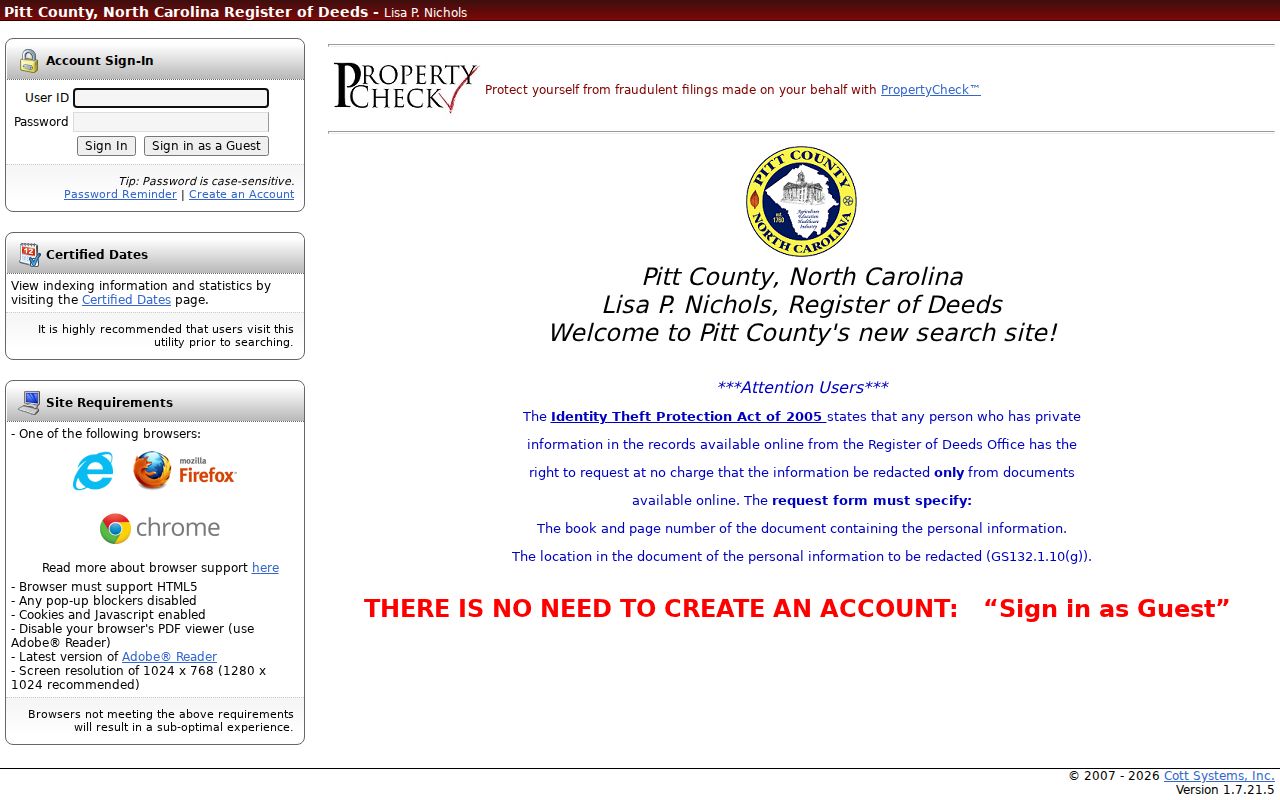
The captured search screen shows why a book and page can be more precise than a broad name query. Its results can display filing date, instrument type, grantor, grantee, legal description, book and page, and image controls. Digital coverage does not guarantee perfect modern name metadata for every old item. Legacy alphabetical books remain an important in-person fallback for spelling problems and early instruments.
| Portal field | Input type | Required | Useful detail |
|---|---|---|---|
| Grantor / Grantee | Party name | One is conditional | Search seller and buyer roles |
| Document Type | Filter | No | Limits the instrument category |
| Book / Page | Number or text pair | Together | Direct record retrieval |
| Date Range | Date pair | No | Narrows filing dates |
| Guest sign-in | Control | No account | Free index entry point |
Greenville Property Record Layers
Pitt County OPIS connects owner names, parcel identifiers, physical addresses, tax mailing addresses, deed references, sales, values, land descriptions, zoning, and district layers. Owner Name accepts contains-style searches, while parcel and NCPIN work best as exact identifiers. Address number and street name are separate inputs. Advanced filters include acreage, tax value, sales price, neighborhood, and fire tax district.
Insider tip: the owner mailing address is a distinct field from the parcel’s physical address. The first is where tax mail goes; the second is the land’s location. A different mailing address can point to an out-of-area owner, but neither field proves who lives at the property. OPIS ownership data update nightly, and the county treats the map as an information aid. Verify title through the recorded deed or plat when precision matters.
- Parcel
- A mapped unit of land identified by county numbers such as parcel, PIN, NCPIN, or REID.
- Situs address
- The physical location of the land, which may differ from the owner’s mailing address.
- Index
- A finding tool that points to a record. It is not the full recorded image.
- Certified copy
- A copy authenticated by the official custodian for formal use.
- Custodian
- The office responsible for keeping and providing a public record.
- Exemption
- A law that keeps specified information from general public access.
Greenville Court Records After 2025
Pitt County joined North Carolina eCourts in April 2025. The statewide Portal now supplies current public party and case access, but the Pitt Clerk remains the keeper of complete local case files and certified copies. Portal Smart Search accepts a party name or case number. Filters can narrow by Pitt County, case type, case status, filing dates, business name, attorney, bar number, or citation number. Public sections may include a case summary, parties, events, hearings, dispositions, and financial details when allowed.
The state’s Court Dates search provides a separate name, citation, and county route for scheduled matters.
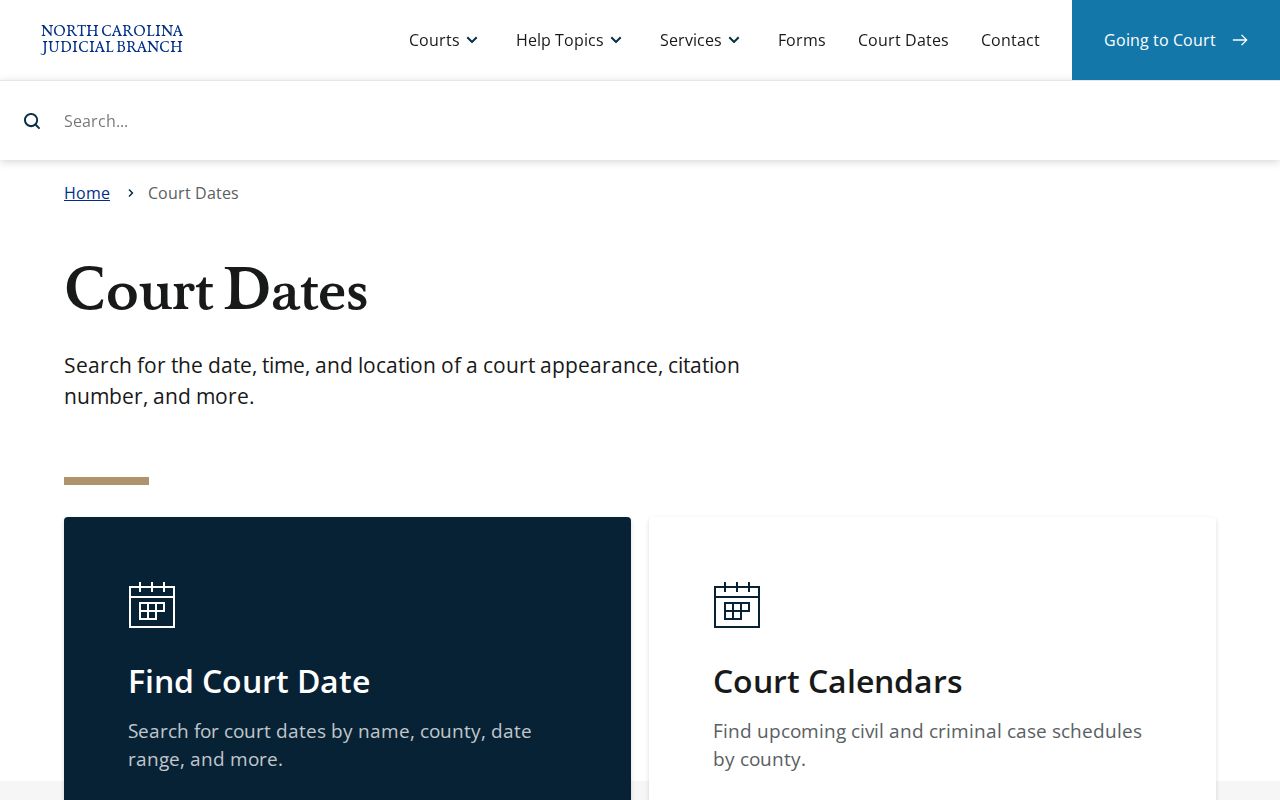
This screen is useful for a hearing check, not as a substitute for the docket or file. Courthouse self-service terminals can search criminal records by defendant, case number, victim, or witness and also expose civil, estate, and special-proceeding data. That victim or witness terminal search can reach beyond the remote Portal’s public party display. Inspect the file at 100 W. Third Street or ask the Clerk for a copy when the online summary stops short.
| Portal result area | What it can show |
|---|---|
| Case summary | Case number, type, status, location, and filing details |
| Party information | Publicly displayed parties and roles, excluding protected victim data |
| Register of actions | Docket events and filed activity |
| Hearings and dispositions | Scheduled events and recorded outcomes when public |
Certified Vital Records Access
Births and deaths that occurred in Pitt County and marriage licenses issued there route through the Register of Deeds. North Carolina Vital Records handles statewide registration and certificates through separate state channels. There is no verified unrestricted official name index for ordinary birth and death certificates. Under G.S. 130A-93, certified-copy access generally belongs to the person named, close family, a direct ancestor or descendant, certain step relationships, someone establishing personal or property rights, or an authorized representative.
The North Carolina Vital Records portal begins new requests and provides case, support, billing, birth, adoption, marriage, death, divorce, and resource areas.
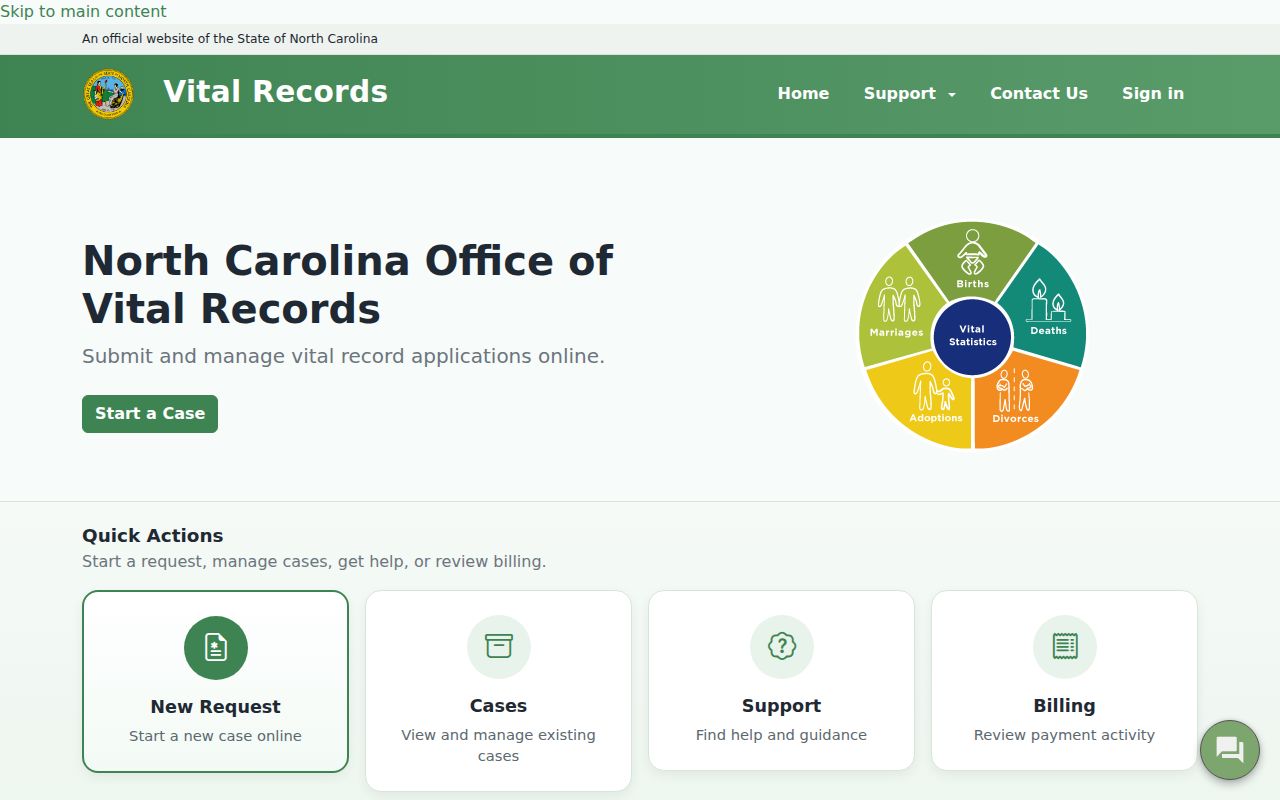
The portal is an application service, not a public people-name browser. Pitt charges $10 for a certified birth, death, or marriage copy. State first-copy or routine no-copy search fees may reach $24, with separate additional-copy and expedited charges. A divorce judgment comes from the Clerk where the case was granted; the state divorce certificate is not the full judgment. Since January 2026, Pitt can issue a $10 amended adoptive certificate through NCDAVE, but the original pre-adoption certificate and adoption file remain sealed.
Greenville Records Law in Practice
The North Carolina Public Records Law, Chapter 132, covers documentary material made or received in public business. It reaches paper, maps, photos, recordings, electronic files, and other formats. G.S. 132-6 allows inspection by any person at reasonable times. A custodian may not demand a purpose or motive. When open and confidential facts share one record, the agency must separate the protected portion instead of withholding everything.
Myth: “as promptly as possible” is not a fixed statewide number of days. Scope, location, review needs, and format affect the response. An agency may satisfy access with an online version that can be viewed, saved, or printed. Chapter 132 also does not force an office to create a new report or compilation that does not exist. A focused request for named records and a bounded date range is easier to locate and price.
G.S. 132-6.2 lets a requester choose any medium the office can provide. Ordinary uncertified copies generally cannot exceed actual reproduction cost. Extensive information-technology or clerical work may support a reasonable special service charge. A database-copy request can be required in writing, and a denial must explain its basis. Keep the response, fee quote, and cited exemption if access remains disputed.
Greenville Records Offices and Portals
The custodian matters more than the website host. A state portal can display a Pitt case without holding the complete case file. The county GIS office can map a parcel without replacing the deed. City departments keep operational records, while the Greenville clerk preserves permanent council and municipal instruments. These primary contacts cover the most common offline routes.
Pitt Register of Deeds
100 E. First St.
Greenville, NC
252-902-1650
Weekdays, 8:00 a.m. to 5:00 p.m.
Office and record services
Pitt Clerk of Superior Court
100 W. Third St.
Greenville, NC
252-695-7100
Counter weekdays, 8:30 a.m. to 5:00 p.m.
Courthouse and counter details
Mail is also available when an office publishes or accepts a written request. Phone first for archival retrieval, an older index, or a file with uncertain custody. State Archives county collections, Sheppard Memorial Library, and ECU Special Collections provide catalog, reading-room, or reproduction routes for older material that no live portal covers.
Greenville Public Records Fees
Search and inspection are often free, but copies and certification are separate services. Pitt lists ordinary uncertified public copies at $0.25 per page and certified recorded copies at $5 for the first page plus $2 for each added page. Certified birth, death, and marriage certificates are $10. Recording fees, such as the charge to file a deed or plat, should not be confused with the cost to inspect or copy an existing record.
NCAOC inspection is free and administrative-record copies are $0.25 per page, with a quoted charge possible for extraordinary requests. NCAOC does not keep individual Pitt case files or certify them. The local Clerk does. Before ordering a large set, ask to inspect it or request an estimate. State law permits actual reproduction cost and narrowly allows special charges for extensive staff or technology work.
Note: Ask whether certification is truly needed before paying for it; a plain copy often answers a research question at lower cost.
Greenville Record Redaction Options
North Carolina G.S. 132-1.10 protects listed identifiers such as Social Security numbers, driver or state ID numbers, passport numbers, financial account numbers, card numbers, PINs, and passwords. Pitt offers a no-fee signed request to redact eligible private information exposed in an online recorded instrument. The request must identify the book and page and pinpoint where the data appears. It may be delivered by mail, fax, email, or in person.
Redaction does not erase the whole deed. It masks eligible information from online display while the public instrument remains part of the Register’s record. Pitt also offers Property Check alerts for new recordings tied to a registered name. An alert warns of a filing; it does not block, validate, or reverse the instrument. Contact the Register promptly if an unexpected notice appears.
Closed and Limited Greenville Records
Several trails narrow for safety, privacy, or court-order reasons. Juvenile matters, sealed or expunged cases, involuntary commitments, most adoption files, and original pre-adoption birth records are not ordinary public Portal records. Only an adoption decree is generally public; the rest requires authorized access. Military discharge records at the Register also receive special protection.
Law-enforcement records have a defined public subset under G.S. 132-1.4. Investigative narratives, intelligence, leads, and protected witness details are not broadly open merely because an arrest or incident occurred. Motor-vehicle personal information is governed by state law and the federal Driver’s Privacy Protection Act, so a plate number is not an open route to a home address. North Carolina’s Address Confidentiality Program uses a substitute address for qualifying survivors, including protected voter registration.
Lawful personal use. Use Greenville records for legitimate family, property, safety, genealogy, or civic research. North Carolina law can punish stalking, repeated harassment, threats, intimidation, and misuse of protected data.
Greenville Records Request Steps
A useful request asks for an existing record, not for staff to investigate a person. Identify the office first. Bring a deed party and book/page, a parcel number and physical address, or a court case number with party names, county, division, and approximate year. Those details reduce mistaken identity and help the custodian find the right file.
- Choose the custodian. Use the Register for land and Pitt certificates, Tax Administration for parcels, the Clerk for case files, Greenville Police for city reports, or the responsible city department for operational records.
- Check the official index. Save the instrument, parcel, case, report, or date identifiers before contacting staff.
- Describe the record. Give the record type, office or division, names, bounded date range, known identifiers, and desired format. No special phrase or stated motive is required.
- Clarify scope and cost. Ask to inspect first or request an estimate when certification, archival retrieval, database work, or many pages may add expense.
- Address any withholding. Ask for the governing statute and a redacted release of the public remainder. Preserve correspondence and invoices.
The North Carolina Judicial Branch offers a separate administrative public-record request route.
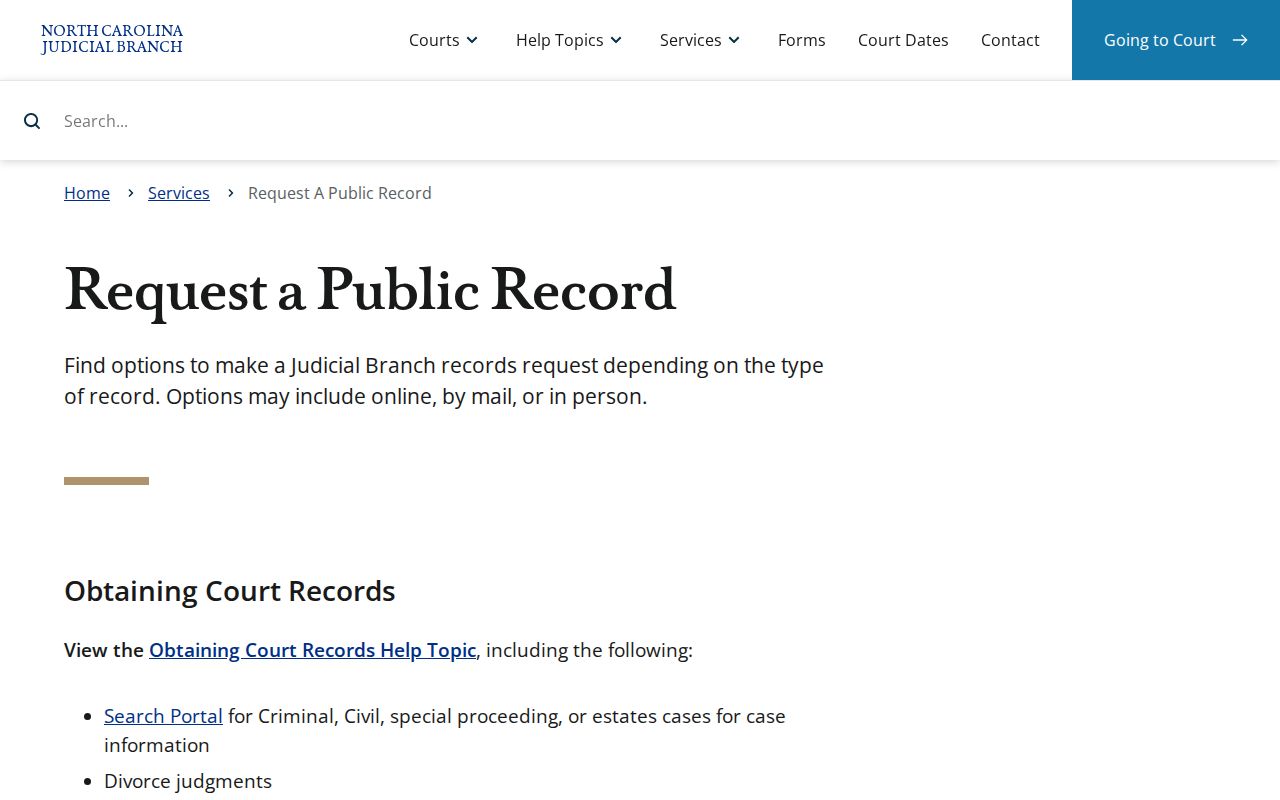
The screen helps distinguish administrative requests from case-copy requests. It cannot order Pitt case documents, build a person’s case history, or obtain birth and marriage records. Those remain with the local Clerk or the proper vital-record custodian.
Greenville Police and Custody Records
The Greenville Police Records Division provides routes for crash, crime, arrest, and case reports online or at 500 S. Greene Street. The Records window operates weekdays from 9:00 a.m. to 4:30 p.m.; call 252-329-4325. Public details depend on the record and the law-enforcement disclosure rules, so an online incident listing may contain less than an eligible report copy.
The Pitt detention lookup covers current detainees and refreshes hourly. It accepts full or partial names or a full booking number; blank criteria can return all active detainees. Results may show charges, sentence, and bond, but custody data can change quickly. North Carolina’s corrections search adds active and inactive prison, probation, and parole records. Registry and custody records support informed personal safety, never threats, stalking, or harassment.